
Home practice, kept short
Build a Home Routine That Sticks
A pelvic floor routine does not need to be long. It needs to be short enough that you will actually do it, and clear enough that you know when a set is finished. This page turns the basic exercise into a daily plan with realistic session lengths, rest cues, and a way to keep track over weeks rather than days.
Set one — five slow holds with a short squeeze and an equal release.
Set two — five quick contractions, then rest as long as you held.
Set three — a couple of minutes, attached to something you already do.
Where to begin
Start with a set, not a schedule
Pick one set you can complete today: five slow holds with a short squeeze and an equal release, then five quick contractions. Do it once. That is your starting point. Published guidance commonly suggests repeating short sets several times per day, with examples ranging from 5 to 10 repetitions per set depending on the source.
Choose the low end first. You are trying to find a set you can repeat, not a set that exhausts you. If the last repetition feels noticeably weaker than the first, the set is too long for now — cut it back and keep the pattern intact.
A first set, plainly
- Five slow holds, squeeze and release matching.
- Five quick contractions, one after another.
- Rest between repetitions at least as long as the hold.
- Repeat the set two or three times across the day.
Session length
How long a session should actually take
A short session is measured in a couple of minutes, not in a workout block. If your set takes longer than that, it is probably too long or the rests are too short. Longer rests are fine. They make the next repetition better.
Many guidance pages recommend short sessions rather than long workouts, and the reason is practical: quality drops fast when a set drags on. Two or three short sets spread across a day do the same work as one long block, and they fit around the day you already have.
Timings are a working frame, not a target to beat. If a set runs past the frame, shorten the hold before you shorten the rest.
Between repetitions
Rest at least as long as you held
If you held for three seconds, rest for three. If you cannot tell whether you have released, take two slow breaths before the next repetition and check. Relaxation is part of the routine, not the gap between routines, and readers who overclench tend to need more rest rather than less.
A set that ends with the muscles still switched on was too dense. The check is simple: before the next repetition, the area should feel soft and quiet, the way it feels when you are sitting still and not thinking about it.
Held three seconds
Rest three seconds before the next repetition. Keep the rest honest rather than rushing it.
Not sure you released
Take two slow breaths, then check. Two breaths cost a few seconds and rescue the next repetition.
Still switched on
Shorten the hold and lengthen the rest. A denser set is not a better set.
Around your day
Fitting practice into a normal day
Attach the set to something you already do. After your morning shower. Before lunch. While the kettle boils. Three short sets across the day is a common pattern, and it spreads the work without turning it into an event.
You do not need a mat, equipment, or a quiet room. Sitting at a desk works. Standing at a counter works. The only thing that changes between positions is how easy it is to tell whether you have fully released.

Morning shower
Dry off, then run one set before you dress. The cue is already in your day.
Before lunch
Sitting at a desk works. Nobody around you can tell you are doing it.
While the kettle boils
Standing at a counter works too. The two minutes are already gone anyway.
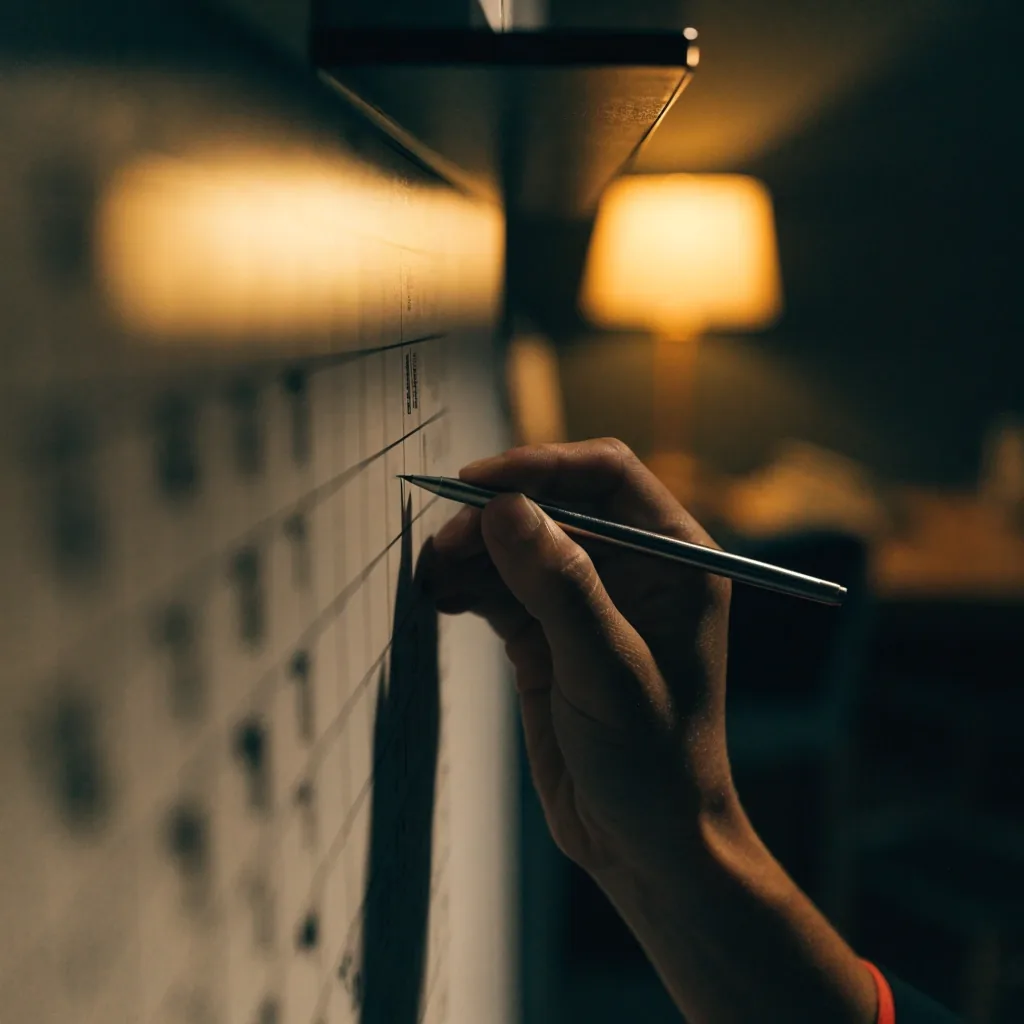
A mark, not a chart
Keeping track without overdoing it
A simple mark on a calendar is enough. Write the date and a single letter for how the set felt: easy, fine, or sloppy. When you see several sloppy days in a row, drop back to shorter holds.
This is not a performance chart, and nobody is grading it. The record exists so you can spot when you have pushed the count too far. If the letters stay on the same note for a month, that is a good month, not a plateau.
Three letters, three responses
Easy
The set finished cleanly and the last repetition felt like the first. Hold the pattern, or add one small change next week.
Fine
It happened, it was unremarkable. This is the normal state of a routine and the one worth aiming at.
Sloppy
You lost the squeeze or the release somewhere in the middle. Note it and shorten the holds next time.
Progression
When to add difficulty
Add difficulty only when the current set feels controlled from the first repetition to the last, and when you can breathe steadily and release fully throughout. Then change one thing: add a second to the hold, or add two repetitions, or move to a harder position.
Change one variable at a time so you know what caused the difference. Michigan Medicine's male pelvic floor guide takes a similar approach, starting with shorter holds and building gradually.
One change
Add a second to the hold
The smallest change you can make, and the easiest to judge. If the last repetition still feels controlled, keep it.
One change
Add two repetitions
Useful once the hold length is settled. Keep the rests where they are so the extra work is the only difference.
One change
Move to a harder position
Sitting, then standing. Harder positions remove some of the support, so the effort changes without changing the count.
Weeks that go badly are part of the pattern. Some weeks you will skip sets. That is normal and it does not undo anything. The response is to restart with an easier set rather than to make up the missed work.
Doubling a session to compensate usually ends with sloppy technique and a longer break afterward. Consistency is treated as more useful than intensity for a reason: it survives a bad week.
After a missed week
Restart easier, not harder
Come back at five slow holds and five quick contractions, even if you had moved past that. One easier week costs less than a long break.
Adjust the set
Signs you should ease off
If a set leaves you feeling clenched rather than released, reduce the hold time. If you cannot breathe steadily, the squeeze is too hard. If you notice yourself bracing your stomach or buttocks, go back to lying down and reduce the effort.
None of these are reasons to stop practicing. They are signals to make the set smaller, which usually makes it more useful. If something persists or worries you, it is worth asking a qualified health professional about it — this page is general information, not personal advice.
Breath feels held
The squeeze is too hard. Reduce the effort until you can breathe steadily through the whole set.
Stomach or buttocks bracing
Go back to lying down and use less effort. The set should not recruit the surrounding muscles.
Feels clenched afterwards
Cut the hold time and lengthen the rest. A smaller set that finishes released is the one worth repeating.
Common questions
What readers ask first
Short answers to the questions that come up most when someone starts a home routine. If your question is not here, the full list covers more ground.
How many repetitions make sense for a beginner?
Start at the low end, such as five slow holds and five quick contractions per set, and repeat the set a few times across the day. Published examples range from 5 to 10 repetitions per set.
How long should a session take?
A couple of minutes is enough for one set. Short sessions are commonly recommended over long workouts because quality drops when a set drags on.
How long should I rest between repetitions?
At least as long as you held. If you cannot tell whether you have released, take two slow breaths before the next repetition.
What if I miss several days?
Restart with an easier set rather than trying to make up the missed work. Doubling a session to catch up usually leads to sloppy technique.
Where to go next
The set is the easy part. What usually decides whether a routine survives is where you place it, how long you rest, and what you do after a week goes badly. Those three pages cover the rest of it.
This resource
Pelvic Floor Practice is an educational resource for men in Indonesia covering practical pelvic floor and Kegel exercise routines, positioning, and everyday care habits. The material here is general information, not personal advice, and it does not promise any outcome.
- Address
- Jl. Cikini Raya No. 58, Menteng, Jakarta Pusat 10330, Indonesia
- Phone
- +62 21 530 2811
- [email protected]
- Hours
- Monday to Friday, 9:00 AM – 6:00 PM; Saturday, 9:00 AM – 1:00 PM